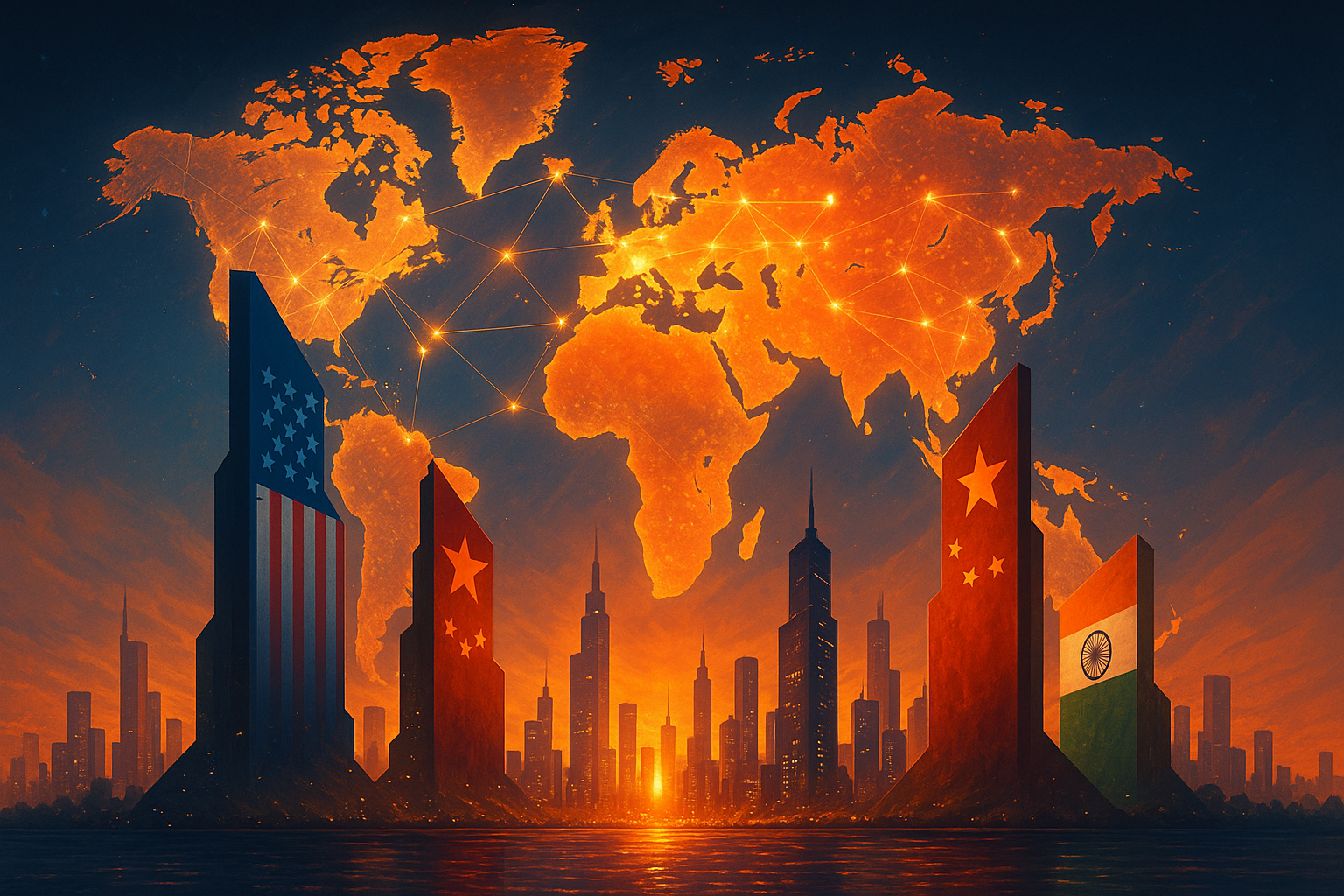
A Changing Global Landscape
The global order we once took for granted — shaped by the Cold War’s bipolar world and decades of Western-led globalization — is now undergoing a profound transformation. The post–Cold War era’s stability is giving way to a more complex, multipolar world. Emerging powers, fast-shifting alliances, technological disruptions, climate pressures and demographic upheavals are creating a landscape more dynamic and unpredictable than at any time in recent history.
Several transformative factors are accelerating this shift. Advances in technology — from artificial intelligence to green energy — are rewriting old equations of economic and military power. Climate change and resource scarcity are creating new zones of competition and vulnerability, influencing migration flows, food security, and geopolitical alignments. Meanwhile, economic balances are tilting: traditional powers struggle with aging populations, slowing growth and debt burdens, while younger, more dynamic societies harness demographic dividends and fresh economic energy.
In short: the future is being shaped by adaptability, innovation, resilience and demographic vitality, not merely by historical legacy or military muscle. This raises a crucial question: Which nations or alliances are best positioned to emerge as architects of world order in the coming decade? Will power stay concentrated among established giants, or will it spread more broadly, reflecting the rise of new players? As we map what may come, understanding these shifting foundations becomes not speculative — but essential.
Current Major Powers — Strengths, Vulnerabilities, and Evolution
The traditional heavyweights — such as the United States, the European Union, China, and Russia — remain central actors in global geopolitics, owing to their economic size, military capabilities, institutional influence, and diplomatic networks. Their existing structures, long-standing alliances, and global reach provide a certain stability to world order.
Yet beneath that strength lie growing vulnerabilities. In many developed economies, demographic decline and aging populations erode long-term competitiveness; workforce shortages and rising dependency ratios strain public finances. In addition, mounting national debt burdens and social pressures — from inequality to political polarization — challenge governance. External pressures like shifting energy markets, trade volatility, and environmental crises further test resilience.
Moreover, global power is no longer just about military or economic might. The rise of technology and information — AI, data control, supply-chain vulnerabilities, climate-driven resource competition — demands adaptability and foresight. For older powers comfortable with status quo, this new terrain is more precarious. Traditional institutions may struggle to keep pace with rapid change.
In other words, while the old powers still matter, the rules of influence are evolving. The question is no longer just “who has strength,” but “who adapts fastest.” The future may favor not only legacy but also agility, innovation, and capacity to respond to global change — qualities that many established powers are struggling to sustain.
The Rise of New Contenders — Emerging Powers and Strategic Blocs
In this shifting global landscape, a fresh set of actors — long relegated to the periphery — are steadily moving toward the center stage. Among them, India stands out. With its youthful population, growing economy, expanding middle class, and rapidly advancing technological and service sectors, the country is shaping up to be a serious global power. Analysts foresee that continued growth and strategic diplomacy could enable India to emerge as a major pole in a multipolar world.
Beyond India, regional blocs and rising economies across Southeast Asia, Africa, South America and other parts of Global South are gaining momentum. The grouping of nations often referred to as the Global South is becoming more assertive — leveraging South–South cooperation, infrastructure investments, and diplomatic mobilization to project influence.
Southeast Asia, under bodies like ASEAN, is increasingly viewed as a strategic pivot region. Rapid economic growth, rising trade, demographic dividends, and geostrategic location make the region attractive for investment and alliances.
Similarly, many African economies — with resource wealth, young populations, increasing urbanization, and growing consumer markets — are poised to rise in global relevance. As global supply chains diversify and demand shifts, these emerging powers and regional alliances could shape trade flows, influence global markets, and contribute to a more distributed world order.
In short, the next decade may not be dominated by a single superpower — but characterized by a constellation of rising powers and strategic blocs. Influence will depend on how these actors balance internal growth, diplomatic agility, and global collaboration.
Non-State & Tech Powers — The Invisible Forces of Influence
The 21st century’s global power equation is increasingly shaped not just by nation-states, but by non-state actors: technology multinationals, data conglomerates, global civil-society institutions, and environmental coalitions. Their influence challenges traditional notions of sovereignty and power.
Large technology firms — especially those leading in AI, data infrastructure, semiconductors, and green-tech — are emerging as power centers. Their control over critical infrastructure, digital communications, and supply-chain components gives them leverage over both economies and national security. As industry and government converge around digital transformation, these firms shape policies, global standards, and even international dependencies. This shift is one of the key megatrends reshaping geopolitics.
Global institutions, non-governmental organizations (NGOs), climate alliances and transnational coalitions also play a growing role. Climate change, in particular, is altering global power dynamics — resource competition, supply-chain risks, migration pressures, and energy transitions are now central to geopolitical strategy.
Moreover, advances in cyber-power, AI, data sovereignty, and information warfare mean that digital dominance may become as crucial as military strength was in the 20th century. Nations and corporations controlling data flows, AI infrastructure, critical minerals, and green-tech supply chains could exercise outsized influence on global affairs.
The result: power is increasingly diffused — across states, corporations, institutions, and networks. In such a world, dominance does not come purely from territory or traditional military strength. It comes from technological control, resource resilience, adaptive governance, and global connectivity. Whoever masters these facets — state or non-state — will shape the next world order.
Challenges to Global Dominance — Climate Crisis, Inequality, Instability
The path to future global dominance isn’t determined only by power, but by the challenges a nation can withstand. Climate change is emerging as the most disruptive force shaping geopolitics. Extreme weather, melting glaciers, water shortages, shifts in agriculture, and rising sea levels will displace millions of people and upend regional stability. Countries facing climate vulnerability must constantly redirect their resources to disaster response rather than development, weakening their influence on the world stage. Resource scarcity, especially of fresh water and critical minerals, will add another layer of geopolitical tension.
Within borders, inequality and polarization threaten to hollow out national unity. Social unrest, mistrust in institutions, and widening economic divides can weaken even the strongest economies. Aging populations challenge developed nations by shrinking workforces and straining welfare systems, while countries with booming youth populations face instability if job creation falls behind aspirations. The pandemic era proved how easily global power can be rattled — supply chains broke, major economies stalled, and nations with weak health systems suffered disproportionate setbacks.
Emerging powers face the toughest balancing act: rapid development must coexist with strong governance, infrastructure resilience, and social harmony. A rising nation that fails to manage corruption, institutional strength, or political stability can collapse under its own ambition. Ultimately, dominance in the next decade will belong not only to those who possess power, but to those who can survive and adapt to unprecedented pressures. Resilience — environmental, economic, and societal — will shape the true hierarchy of global influence.
Possible Scenarios for 2035 — Competing Orders
The next world order may not look like anything we’ve known before, and several futures are equally plausible. One scenario is a stable multipolar world where power is shared among several major players — the United States, China, India, the European Union, and a few regional coalitions. In this model, global decisions are shaped through negotiation rather than dominance. Another possibility is a technology-centered order where alliances are built around control of AI ecosystems, semiconductor supply chains, cyber defense networks, and data governance. Influence would then depend on innovation and digital infrastructure rather than territory or conventional military might.
A third scenario points toward strong regional power clusters. Different areas of the world may fall under the influence of localized leaders — Asia anchored by India or China, Europe as an economic regulatory hub, and Africa rising with demographic and resource strength. Global leadership becomes more distributed, and nations rely on regional partnerships over distant alliances.
The most uncertain scenario is a fragmented, unstable world shaped by continuous economic and security shocks — climate emergencies, cyber-wars, migration crises, and protectionist policies. Alliances would shift frequently, and no nation would sustain clear leadership. Which path the world chooses will depend greatly on how countries respond to global crises: through competition and isolation, or through cooperation and shared resilience. The future is not fixed — it will be written by the decisions we make in the next decade.
What Could Tip the Balance — Key Variables to Watch
Several forces will act as tiebreakers in determining who leads tomorrow’s world. Demographics remain a powerful predictor of national vitality. Countries with young, energetic populations — such as India and many African nations — have a chance to surge ahead if they educate and empower their youth. Conversely, nations with aging populations face slower growth and rising economic burdens unless they reinvent their labor models and social systems.
Technological leadership is equally decisive. The race for supremacy in artificial intelligence, quantum computing, green energy, and biotechnology will determine economic dominance and modern military power. Whoever controls these technologies will shape global standards, data flows, and intellectual ecosystems. Another tipping factor is access to essential resources. Water, sustainable energy, rare earth minerals, and food security will define alliances and influence conflicts. Nations with diversified, resilient supply chains will thrive while others face vulnerability.
Finally, governance quality may matter more than geography or size. Countries that maintain trust in institutions, manage crises effectively, and adapt to rapid change will outperform those trapped in political dysfunction. In essence, the winners of the next world order will be not merely the strongest — but the smartest, most innovative, and most capable of uniting their people around a shared future.
Who Has the Edge, and Why It Still Matters
There may be no single ruler of the world in the next ten years. Power is dispersing, influence is shifting, and leadership will be shared across nations and networks rather than concentrated in one empire. The United States may retain military dominance, China economic leverage, India demographic and cultural advantage, the European Union regulatory and sustainability leadership, and technology corporations digital power beyond national boundaries. But the real advantage will belong to those capable of adapting quickly — pivoting when disruptions strike, investing in innovation, and building societies that are both strong and united.
Why does this matter? Because global power affects everyday life — from economic opportunity to freedom, security, climate action, and human rights. The shape of world leadership decides whether the next decade brings peace and progress or fragmentation and conflict. The future will reward nations and institutions that act responsibly, collaborate intelligently, and lead with both strength and ethics. In the end, the world order of 2035 will not be defined by sheer size — but by resilience, innovation, and the will to shape a better future for humanity.
Related Posts

Mahashivratri: The Night of Awakening and Inner Transformation
Behavioral Changes in Relationships: Understanding Emotional Distance and Hidden Signals