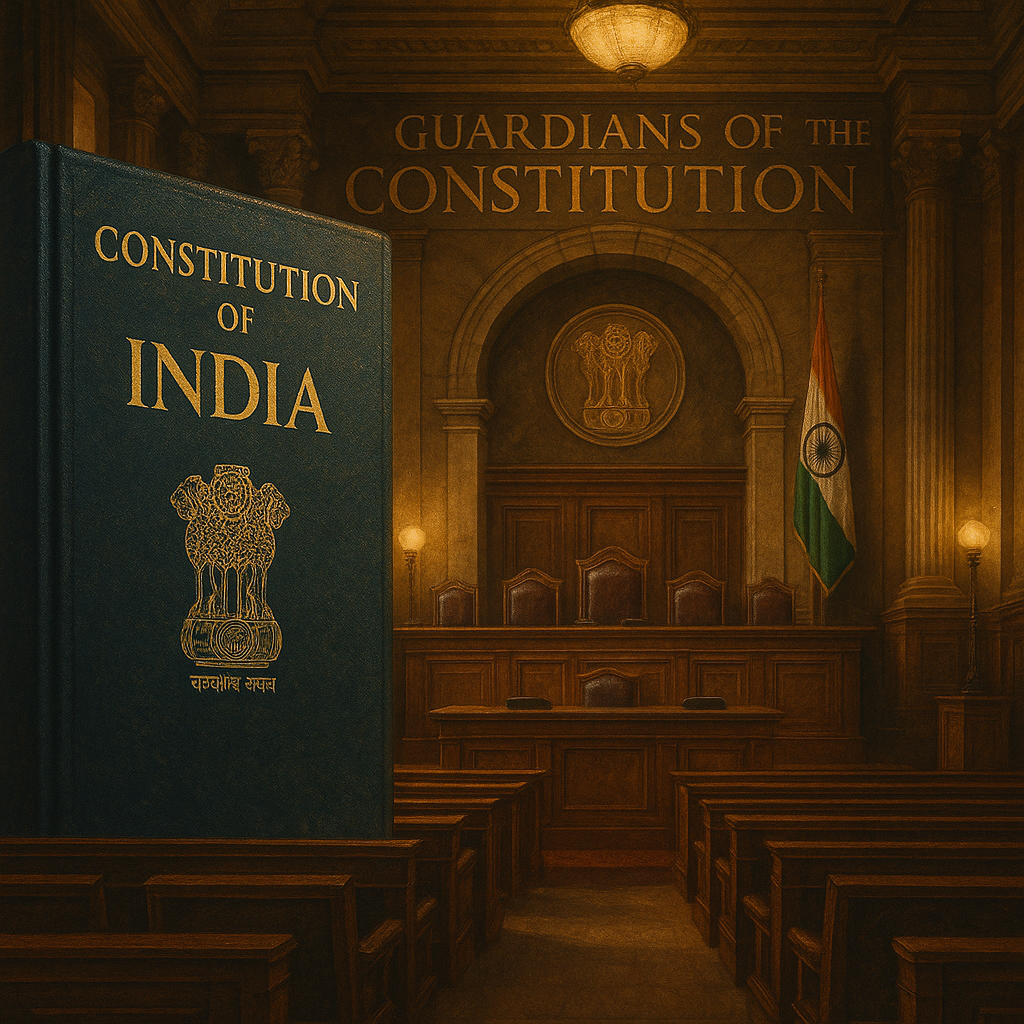
The Judiciary as the Backbone of Democracy
Every democracy stands on three pillars — Legislature, Executive, and Judiciary. The first two create laws and run the government. But the third ensures that neither misuses power. That is why the judiciary is called the backbone of democracy. Without it, rights would be theoretical, and the Constitution would be only a written text, powerless to protect the people.
The Constitution declares itself the supreme law of the land, and the judiciary is entrusted with defending its principles. Courts resolve disputes, interpret law, and protect fundamental rights from being violated by the state or any authority. When power attempts to overstep its boundaries, the judiciary steps in as the constitutional safeguard.
Yet many citizens understand only the surface of how the judiciary functions. They see major headlines or political controversies — but not the silent, daily work that keeps justice alive across India.
This article aims to explain that system in clear terms:
-
How courts are structured from the grassroots to the Supreme Court
-
How judicial review allows the courts to strike down unconstitutional actions
-
How independence ensures that judges cannot be influenced by political forces
-
How courts protect rights, especially for those who cannot protect themselves
-
And how the judiciary continues to evolve with technology and reform
Ultimately, the judiciary is not just a dispute resolution forum. It is the guardian of the Constitution, the defender of democracy, and the protector of citizens against any form of injustice — whether it comes from the street or the highest corridors of power.
The Architecture of Justice — Courts at Three Levels
India has one of the world’s largest and most complex judicial systems — designed to make justice accessible from metropolitan cities to rural districts. It is structured in three levels:
1- Supreme Court of India
Located in New Delhi, it is the highest court, hearing constitutional matters, national importance issues, and final appeals.
2- High Courts
There are High Courts for each state or group of states. They supervise and guide subordinate courts while also handling major civil and criminal appeals.
3- Subordinate Courts
At the district and taluka levels, these courts handle the vast majority of cases — civil disputes, criminal trials, family matters, and consumer issues.
This hierarchy ensures that ordinary legal matters are solved locally, while serious questions of law can climb higher until they reach the Supreme Court.
The distribution of jurisdiction includes:
-
Constitutional cases – tested primarily in High Courts or the Supreme Court
-
Criminal cases – usually begin in lower courts, with appeals upwards
-
Civil disputes – property, employment, family litigation
-
Administrative and tribunal matters – specialised domains like tax or company law
This layered architecture serves two goals:
✔ Accessibility — the average citizen can approach a nearby court without needing to travel or spend heavily
✔ Accountability — a higher court is always available to review and correct errors
India’s judicial pyramid may be vast, but its design ensures that justice can reach the remotest part of the country — while still allowing important legal questions to rise to the top where constitutional interpretation takes place.
Judicial Review — The Supreme Court’s Most Powerful Tool
The Constitution grants the Supreme Court a power that defines its role in democracy: Judicial Review. This allows the court to examine any law, government order, or executive action — and strike it down if it violates the Constitution.
This power is essential because even elected governments can make mistakes or misuse authority. Judicial review ensures that laws do not trample upon:
-
Fundamental Rights
-
Balance of federal power
-
The Basic Structure of the Constitution
The Basic Structure Doctrine, evolving through landmark judgments, asserts that no authority — not even Parliament — can alter the foundational principles of democracy, such as:
-
Separation of powers
-
Rule of law
-
Secularism
-
Judicial independence
-
Fundamental rights and dignity
If any law threatens these core values, the Supreme Court can declare it unconstitutional.
Another vital contribution is the development of procedural fairness, ensuring that laws are not only legal in their text but also fair in their execution — strengthening due process in governance.
Judicial review protects democracy by:
✔ Preventing authoritarian abuses
✔ Ensuring rights remain enforceable
✔ Holding the state accountable to the Constitution
It is this power that turns the Supreme Court into more than just a dispute resolver — it becomes a constitutional conscience keeper, ensuring that India remains a democracy not just in elections, but in every legal decision that touches a citizen’s life.
Independence of the Judiciary — Beyond Political Influence
For the judiciary to function as a protector of rights, it must be free from political pressure. The Constitution carefully establishes this independence through both institutional and personal safeguards.
One such system is the Separation of Powers — the Legislature makes laws, the Executive implements them, and the Judiciary interprets them. None can interfere with the core powers of another.
Judicial appointments to the Supreme Court and High Courts are controlled by the Collegium System, where senior judges select new judges. This prevents the government from choosing judges who may favour it. Additionally, judges enjoy:
-
Security of tenure — they cannot be easily removed
-
Protection of salaries — not altered to weaken independence
-
Contempt power — to act against interference or disrespect
-
Financial autonomy — operational decisions not dictated by government
These protections ensure that judges can question or strike down government actions without fear of punishment.
Independence is not a privilege for judges — its purpose is to protect citizens. When fundamental rights are violated, the judiciary must be free to stand up to the state. If judges were under political influence, justice would lose fairness and credibility.
However, independence also comes with responsibility. The judiciary must maintain transparency, ethical integrity, and accountability to ensure public trust.
Together, these elements equip courts to remain impartial guardians of democracy — wielding power not for institutions, but for the people they serve.
Protecting Citizens — Fundamental Rights and Remedies
The Constitution promises every Indian certain Fundamental Rights — to equality, freedom, dignity, and more. But rights mean little unless people have a way to enforce them. That is why the judiciary plays a direct and crucial role in ensuring that citizens can challenge violations of their rights.
Under Article 32, any citizen can approach the Supreme Court directly if their fundamental rights are infringed. Dr. B. R. Ambedkar famously called Article 32 the “Heart and Soul of the Constitution” because it guarantees the ability to seek protection against state actions.
Similarly, High Courts exercise wide-ranging powers under Article 226, enabling citizens to seek remedies even for legal rights that are not fundamental. They also act faster due to their proximity and regional jurisdiction.
Courts use tools called Writs to enforce rights:
-
Habeas Corpus — release wrongfully detained individuals
-
Mandamus — compel officials to perform duty
-
Certiorari & Prohibition — stop unlawful actions of lower courts
-
Quo Warranto — question authority in public offices
These powers ensure that:
– Nobody can be detained unlawfully
– Government acts within legal limits
– Citizens are protected from discrimination, censorship, and abuse of power
Most importantly, courts provide a voice to those who have none — the poor, marginalised, or oppressed. Often, the judiciary becomes their only shield when other institutions fail.
Thus, the judiciary doesn’t just interpret rights — it activates them. It ensures that constitutional promises are not decorative ideals, but living guarantees that defend human dignity every day.
Accountability of the Powerful — Courts vs Government
In a democracy, power must never go unchecked — and the judiciary ensures exactly that. The Supreme Court and High Courts have the authority to review both legislation (laws passed by Parliament and State Legislatures) and executive actions (decisions of the government and its agencies). If any action violates constitutional principles, the judiciary can step in to correct or strike it down. This role is not adversarial by design; it is a constitutional mandate to prevent any institution from becoming arbitrary or authoritarian.
Throughout India’s history, courts have often acted as the voice of constitutional morality — even when it meant standing against the government of the day. From restoring democratic rights during political crackdowns to ensuring transparency in governance and upholding civil liberties, the judiciary’s interventions have shaped national destiny. These confrontations demonstrate that a functioning democracy requires institutions that can question power without fear.
Judicial oversight provides critical checks and balances by:
-
Examining the constitutionality of new laws
-
Ensuring the Executive respects human rights and legal limits
-
Protecting the electoral process, media freedom, environmental safeguards, and minority rights
This accountability is not meant to weaken governance but to strengthen the rule of law. When courts correct unconstitutional actions, they are not antagonists — they are guardians of the framework within which government must operate. Without this accountability, democracy risks turning into majoritarian rule, where rights become vulnerable and justice becomes selective.
Public Interest Litigation — Justice for the Marginalised
One of India’s most transformative judicial innovations has been Public Interest Litigation (PIL). It evolved from the belief that courts should not remain inaccessible to those who cannot afford lawyers or lack legal knowledge. Through PILs, activists, lawyers, or even ordinary citizens can approach the courts on behalf of disadvantaged groups. This dramatically expanded the reach of justice in India.
PILs have led to major reforms in:
-
Environmental protection
-
Women and child rights
-
Prisoner rights and police accountability
-
Transparency in public institutions
-
Protection of historic and community assets
It turned the judiciary into a proactive force for social change. Marginalised communities, who were once voiceless, found representation in the highest courts of the land.
However, its success has also attracted misuse — with some PILs filed for political publicity, personal interest, or to delay government projects. Recognizing this, the courts have set safeguards to ensure that only petitions with genuine public interest are entertained.
Despite these challenges, PIL remains one of the most powerful tools for democratic participation. It reinforces a fundamental truth: justice cannot be limited to those with privilege. By allowing the courts to intervene where suffering goes unnoticed, PIL has changed the relationship between the citizen and the judiciary — empowering people to demand fairness not as charity, but as a constitutional right.
Challenges Facing the Judiciary Today
While the judiciary is integral to democracy, it faces significant challenges that affect the delivery of justice. The most pressing concern is the huge backlog of cases — more than 4.5 crore pending across all courts in India, including tens of thousands in the Supreme Court alone. Delays result from multiple factors: judge shortages, procedural complexities, and overwhelming reliance on litigation in society.
Infrastructure gaps also burden the system — many lower courts lack adequate staff, technology, and facilities. Accessibility still varies widely across regions, affecting the ability of citizens to seek timely justice.
Another debate concerns judicial transparency and overreach. Critics argue that courts sometimes step into areas meant for elected bodies, blurring the separation of powers. On the other hand, supporters believe these interventions are necessary where governance fails. Striking the right balance remains a continuing challenge.
Reform proposals include:
-
Increasing judicial appointments
-
Streamlining procedures and case management
-
Promoting mediation and alternative dispute resolution
-
Expanding technology adoption
-
Investing in infrastructure, especially at lower levels
The judiciary must evolve without compromising independence, which is its greatest strength. Reforms should enhance efficiency while preserving the court’s role as the protector of rights and constitutional values. Strengthening the system is essential not just for legal efficiency but also for maintaining public trust in justice.
The Judiciary in a Digital India
India’s judiciary is entering a new era powered by digital transformation. Virtual hearings, introduced widely during the pandemic, have now become a permanent part of the system. Lawyers can argue from anywhere in the country, reducing travel costs and broadening access — especially for litigants from remote areas.
E-courts and digitised case records have eased access to files, enabling real-time tracking of case status and reducing delays caused by paperwork. Digitisation also increases transparency, reducing administrative bottlenecks.
Discussions on live-streaming courtroom proceedings, especially constitutional cases, reflect a push toward greater public visibility. For a democracy to thrive, justice must not only be delivered but also be seen being delivered — technology has become the tool to make that possible.
Digital efforts also boost legal awareness among citizens by:
-
Providing online access to judgments and legal rules
-
Enabling easier filing of petitions
-
Making legal knowledge publicly available
However, the digital divide remains a challenge. Reforms must ensure that technology does not exclude those without access to devices or connectivity.
The future of India’s judicial system lies in combining traditional constitutional principles with modern technological tools, ensuring justice delivery remains efficient, fair, and inclusive. A digitally empowered judiciary brings the promise of justice closer to every citizen.
Courts as the Keepers of India’s Democratic Soul
The judiciary is not just another government institution — it is the living protector of the rights and freedoms that define India as a democracy. It ensures that laws reflect justice, not power. It holds rulers accountable to the Constitution. It stands as the final barrier between liberty and oppression.
But the judiciary cannot function in isolation. Its effectiveness depends on an informed and vigilant public — citizens who understand their rights, respect legal processes, and support institutional independence. Trust in the judiciary strengthens the rule of law; cynicism weakens democracy itself.
Courts ensure that democracy does not end at the ballot box. They guarantee that individuals retain dignity, equality, and freedom every single day. From the smallest district courtroom to the majestic Supreme Court, judges carry a profound responsibility — to ensure justice prevails, even against the strongest forces.
As long as India’s judiciary remains independent, accessible, and guided by constitutional morality, the soul of democracy remains protected. Because the true measure of a nation is not only in how it elects its leaders — but in how it safeguards its people.
Related Posts

Mahashivratri: The Night of Awakening and Inner Transformation
Behavioral Changes in Relationships: Understanding Emotional Distance and Hidden Signals