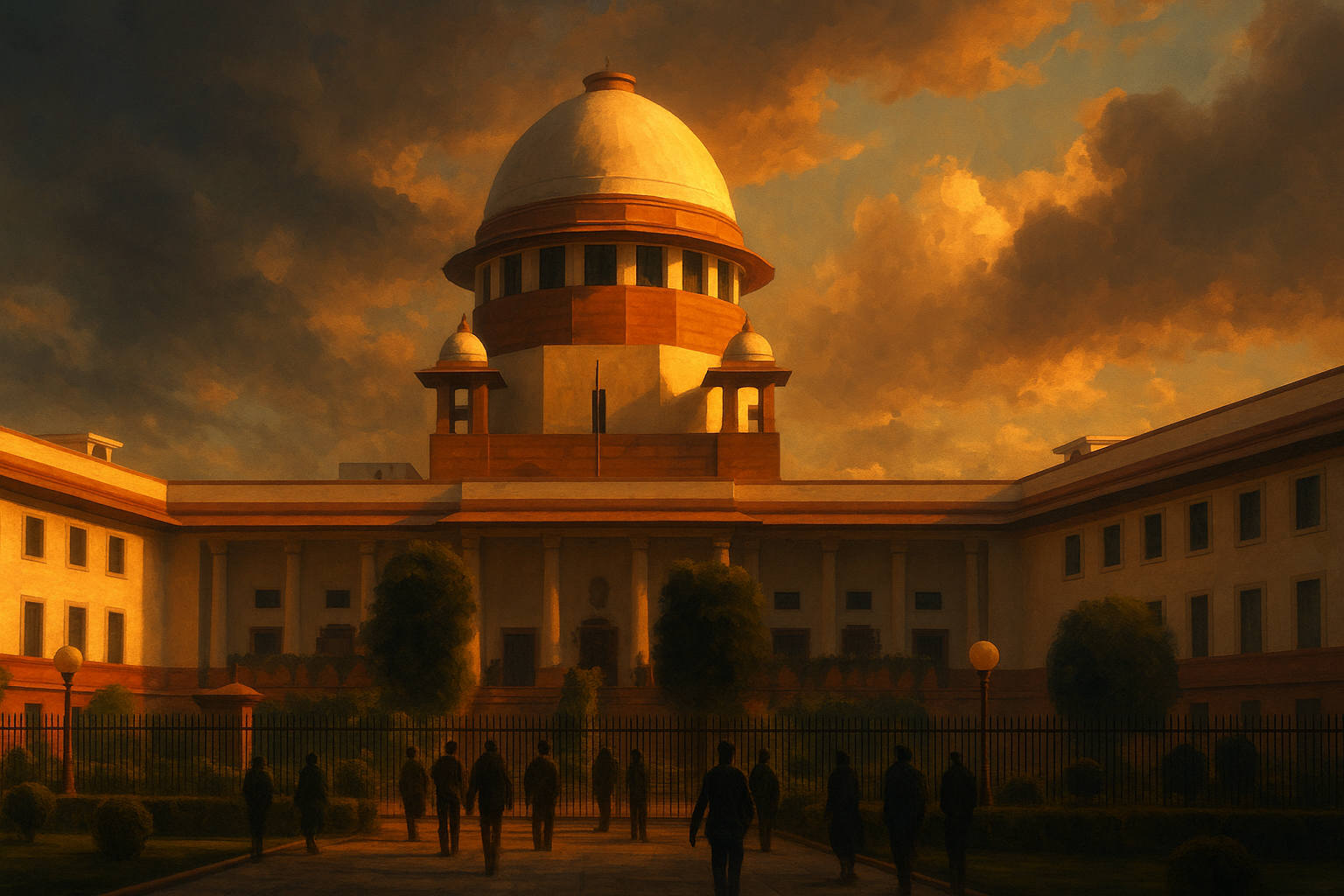
The Court at the Top
The Supreme Court of India stands at the very top of the country’s judicial pyramid. It is not just the highest court of appeal; it is the guardian of the Constitution and the ultimate protector of fundamental rights. When state governments disagree, when constitutional principles are questioned, when the common citizen feels justice has not been served in the lower courts — this is the institution that steps in. Yet, for most people, the Supreme Court remains an abstract concept: a grand building in Delhi, images of senior lawyers in black coats, and headlines about landmark judgments. What actually happens behind those courtroom doors often feels mysterious and distant.
Part of the misunderstanding arises from complexity. Legal procedures, constitutional language, and judicial traditions can feel intimidating to those outside the profession. Many assume only political cases or extremely serious criminal matters reach the Supreme Court. Others imagine it functions like a regular courtroom but on a bigger scale. In reality, its role is far more unique and layered.
This article aims to make the Supreme Court easier to understand — not through heavy legal jargon, but through a simple breakdown of how it works. How is the court structured? Which cases reach it? How does a petition move through the system until a judgment is delivered? By exploring these questions clearly, we can appreciate not only what the Supreme Court does, but why it matters so deeply in a democracy like India. Because a justice system becomes stronger when the people it serves understand how it functions — and the Supreme Court sits at the very heart of that promise of justice.
How the Supreme Court is Structured
At the head of the Supreme Court sits the Chief Justice of India (CJI), supported by a sanctioned strength of 34 judges in total, including the CJI. These judges together form different benches depending on the nature and importance of a case. The court does not function as one single group — instead, several benches sit simultaneously to handle the thousands of matters listed each day.
There are three primary types of benches:
-
Constitution Bench — consisting of five or more judges, used for cases involving interpretations of the Constitution or matters of national significance.
-
Division Bench — generally two judges, hearing most appeals and major legal matters.
-
Single Judge Bench — used for specific categories of cases like bail or procedural orders (less common at the Supreme Court compared to High Courts).
One of the most debated aspects of the Supreme Court’s functioning is its judicial appointment process — known as the Collegium System. This is a body of the Chief Justice and the four senior-most judges who collectively recommend appointments and transfers of judges to the higher judiciary. The government’s role is mostly limited to formal approval, although it may raise objections. This system is based on judicial independence, ensuring that the Executive does not interfere in who becomes a judge.
Judges of the Supreme Court retire at the age of 65. There is no reappointment to the Supreme Court after retirement, but retired judges may serve on tribunals or as heads of commissions when required.
This structure ensures that India’s highest court remains both flexible — to handle a wide range of cases — and stable — with experienced judges interpreting the Constitution and setting judicial standards for the entire nation.
What Cases Reach the Supreme Court?
Not every matter can go directly to the Supreme Court. In fact, the court selects which cases it will hear, with the goal of focusing on issues of national importance and major legal questions. The Constitution grants the Supreme Court three key types of jurisdiction:
1. Original Jurisdiction
Certain disputes come straight to the Supreme Court without passing through lower courts. This includes conflicts between:
-
Two or more state governments
-
A state and the Union Government
These cases involve federal structure and constitutional balance, making the Supreme Court the first and final authority.
2. Appellate Jurisdiction
Most cases reach the Supreme Court as an appeal from High Courts — both in civil and criminal matters. Appeals typically involve:
-
A substantial question of law
-
Potential miscarriage of justice
-
Interpretation of constitutional principles
3. Advisory Jurisdiction
Under Article 143, the President of India may seek the Supreme Court’s opinion on important legal or public issues. While this opinion is not binding, it carries immense influence.
Among all these routes, one stands out in volume: the Special Leave Petition (SLP). Under Article 136, the Supreme Court can grant special permission to appeal against any judgment from any court or tribunal in the country. This makes the SC accessible even when no automatic right to appeal exists. Over 60% of the cases admitted in the Supreme Court come through SLPs — which is why the court is often overloaded.
In short, the Supreme Court is not a court of everyday disputes — it is a court that steps in when the law itself, or justice itself, needs protection.
How Cases Get Heard — The Journey of a Petition
A case does not reach the Supreme Court simply by filing a petition; it must first pass the admission stage. The journey begins when a petitioner files all required documents with precise legal grounds. The Court Registry checks whether the paperwork is complete and whether the case falls under the SC’s jurisdiction.
Next comes Admission Hearing — a preliminary evaluation by a two-judge bench. During this brief session:
-
The petitioner’s lawyer explains why the case deserves to be heard
-
The court decides whether to issue a notice to the opposing party
-
If the court is not convinced, the petition is dismissed at this stage — which happens often
If notice is issued, the case receives a place in the Cause List — the daily schedule of cases — and is assigned to a suitable bench depending on the legal issue. Inside the courtroom, the process is a dynamic exchange:
-
Lawyers present arguments
-
Judges question both sides
-
Legal precedents and constitutional provisions are examined
Written submissions, affidavits, and documented evidence also play a crucial role. The court may reserve judgment after hearings, spending weeks or months deliberating internally before delivering a decision.
Once a judgment is pronounced, it becomes binding law across India unless overturned by a larger bench or constitutional amendment.
While the courtroom may look like a place of debate, it is ultimately a space for constitutional reasoning and justice — making the journey of a petition not just legal, but deeply democratic.
How Decisions Are Made
Once arguments in a case are completed, the judges do not immediately announce their decision. They withdraw from the courtroom and enter a phase known as deliberation — a careful and confidential process where legal reasoning is debated, case records studied, and interpretations weighed against constitutional principles. This stage is critical, because the Supreme Court’s judgments often shape not just the lives of the parties involved, but the future of the law itself.
Most cases are heard by two-judge division benches. However, when a question involves deep constitutional interpretation or conflicting past rulings, the case goes to a larger bench, such as a five-judge Constitution Bench. After deliberation, judges write their judgments — either jointly or individually.
The decision is based on majority rule. If three judges agree and two disagree, the majority opinion becomes the binding judgment. But in India’s judicial culture, dissenting opinions are preserved and published. These dissents have often influenced future changes in the law — proving that disagreement in the present can become a guiding light for tomorrow.
Every Supreme Court ruling becomes a judicial precedent, which all lower courts across India must follow, unless overturned by a larger bench or constitutional amendment. This doctrine of stare decisis ensures consistency and stability in the legal system.
At the foundation of every judgment lies one core priority: constitutional interpretation. The Supreme Court is not merely deciding a dispute — it is protecting the rule of law and ensuring that democracy survives not only in elections but in everyday governance. Its decisions reflect how the Constitution continues to evolve along with society.
Public Interest Litigation (PIL) — The People’s Tool
One of India’s most remarkable contributions to the global legal system is Public Interest Litigation (PIL). Introduced in the late 1970s and early 1980s, PIL changed access to justice dramatically. Earlier, only the affected individual could approach the court. With PIL, any concerned citizen can file a case on behalf of others who are disadvantaged, exploited, or unaware of their rights.
PILs can address a wide range of issues:
-
Environment protection
-
Human rights violations
-
Consumer rights
-
Corruption and accountability
-
Social welfare and marginalised groups
This tool turned the Supreme Court into a genuine “people’s court,” enabling landmark reforms that have improved governance and strengthened democracy.
However, with its power comes criticism. Some PILs are seen as publicity-driven or politically motivated, burdening the court and distracting focus from genuinely urgent matters. The judiciary has responded by setting clear guidelines to prevent misuse — while still keeping the door open for vulnerable communities who depend on the court to speak for them.
Despite its challenges, PIL remains a shining example of judicial activism. It embodies the idea that justice cannot only belong to those who can afford lawyers or understand legal procedures — it must be available to every citizen. In many ways, PIL is not just a legal mechanism; it is a statement that in a democracy, public interest belongs inside the courtroom.
The Role of Lawyers and Senior Advocates
The Supreme Court has a unique system to ensure quality representation. Only specially qualified lawyers known as Advocates-on-Record (AORs) are permitted to file petitions before the Supreme Court. They carry full legal responsibility for documents and procedural accuracy. On the other hand, Senior Advocates are experienced lawyers recognized for excellence in advocacy. They argue high-profile cases with expertise in constitutional and complex legal matters — often becoming the public faces of courtroom battles.
Some lawyers gain significant visibility because they handle major political and corporate cases. Their influence comes not from showmanship but from mastery over legal strategy, clarity of arguments, and confidence before the bench. In a court where time is limited and judges are deeply informed, how an argument is structured can often be the turning point.
At the same time, the Supreme Court also ensures representation for those who cannot afford high-profile lawyers. Through the Supreme Court Legal Services Committee, free legal aid is provided to financially weaker citizens. This fulfills a core constitutional promise — that justice should not be determined by the size of one’s wallet.
Thus, lawyers at the Supreme Court serve not just clients but the larger cause of justice. Their duty lies in helping judges arrive at the truth by presenting the case with clarity, honesty, and respect for judicial ethics.
Technology, Transparency & Court Reforms
India’s Supreme Court — a historically traditional institution — has undergone a major digital transformation in the past decade. The introduction of e-filing, virtual hearings, and digitized records has made litigation more accessible, especially after the pandemic accelerated modernization. For the first time, lawyers across the country can argue cases without being physically present in Delhi, making the justice system more inclusive.
Talks about live-streaming proceedings for constitutional matters have strengthened transparency, allowing citizens to witness the judiciary in action. This is an important shift because a democratic court must not only deliver justice — it must be seen delivering justice.
However, despite technological progress, India’s judiciary faces a significant challenge: pendency of cases. With more than 70,000 matters pending before the Supreme Court alone, delays remain a major concern. Reasons include shortage of judges, frequent adjournments, and the vast scope of matters that reach the court through SLPs.
Reform proposals include increasing judicial strength, promoting mediation, restructuring listing procedures, and applying technology to streamline case management. The aim is to ensure that the right cases reach the court, and that judgments are delivered with necessary speed without compromising fairness.
Balancing transparency with judicial discipline is essential. The court must remain open to scrutiny while ensuring proceedings are respectful and orderly. Modernization is a continuous process — but each step toward reform brings the court closer to the ideal of timely, accessible, and efficient justice.
Why the Supreme Court Matters
The Supreme Court is far more than the final stop for legal appeals. It is the guardian of the Constitution, the defender of rights, and the ultimate check on power. When individual freedom is threatened, when institutions fail, when government actions need accountability — the Supreme Court stands as the last hope for justice.
Understanding how the Supreme Court works enables citizens to appreciate not just judgments but the democratic values behind them. Courts thrive when the public they serve is aware, informed, and engaged. Judicial institutions gain strength when citizens participate in civic dialogue rather than remain distant or unaware.
The Supreme Court’s authority is immense, but so is its responsibility. Every decision must balance the letter of the law with the spirit of the Constitution. It is a living symbol of how democracy is not just voted into existence — it is protected every day inside those courtrooms.
As long as the Supreme Court remains independent, accessible, and guided by constitutional morality, India’s democratic promise stays protected. Its workings may be complex, but their purpose is simple:
to ensure justice not as a privilege, but as a right for every citizen.
Related Posts

Mahashivratri: The Night of Awakening and Inner Transformation
Behavioral Changes in Relationships: Understanding Emotional Distance and Hidden Signals