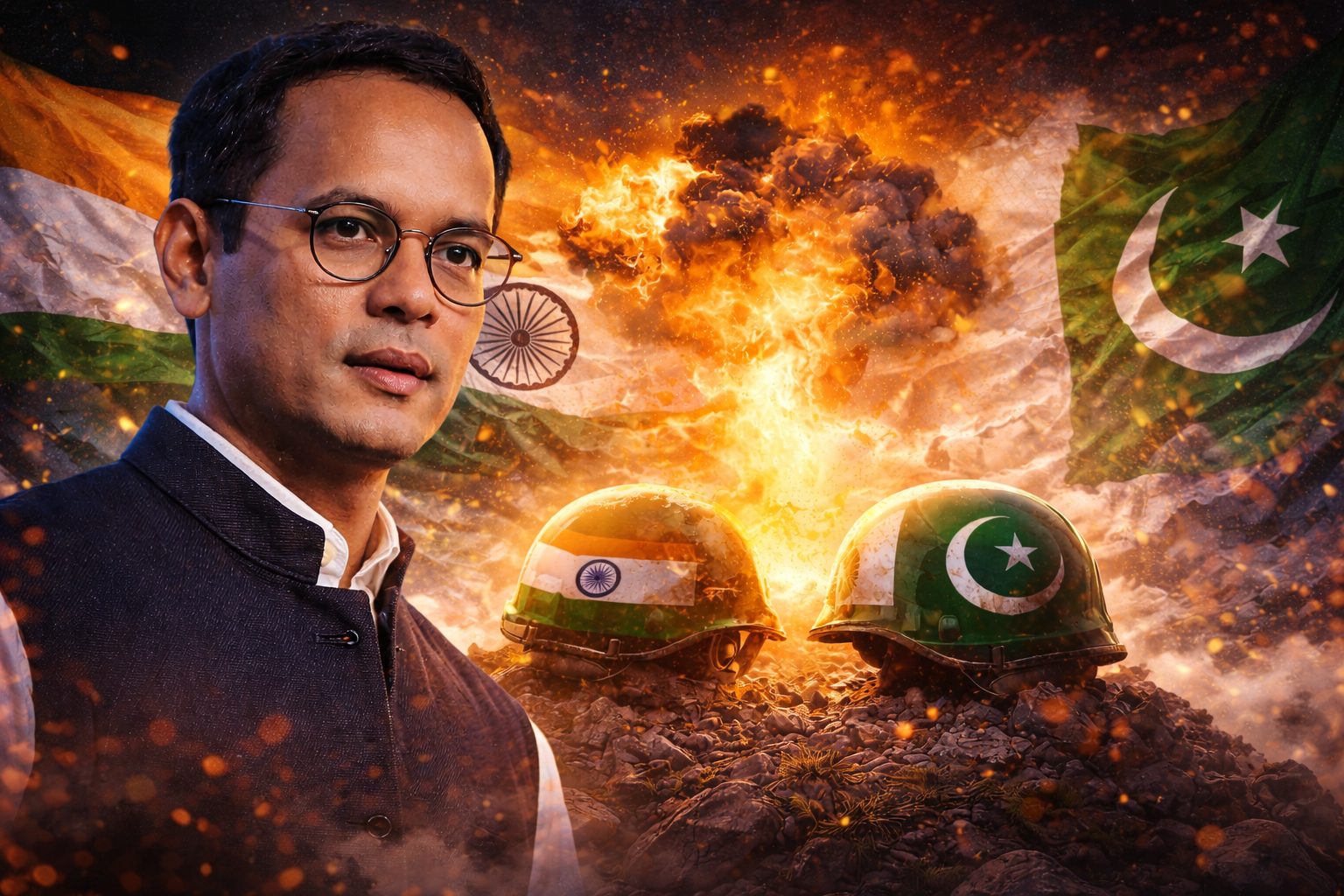
A political storm has erupted in India following serious allegations leveled by Assam Chief Minister Himanta Biswa Sarma against Congress MP Gaurav Gogoi, focusing on a mysterious 10-day visit to Pakistan. Sarma has presented a narrative suggesting a clandestine trip with grave national security implications, while Gogoi has offered his own explanations, leading to a heated public discourse.
The core of the controversy revolves around a specific visit made by Gaurav Gogoi to Pakistan. According to Himanta Biswa Sarma, Gogoi initially obtained a visa for Lahore. However, upon his arrival in Lahore, a letter from Pakistan’s Ministry of Interior reportedly allowed him to travel to Karachi and Islamabad. The critical point of contention, as highlighted by Sarma, is the absence of a valid visa for Rawalpindi. Sarma claims that despite this, Gogoi later confessed to visiting Taxila, which is located in the Rawalpindi district—the acknowledged headquarters of the Pakistan army. This raises significant questions, as Sarma points out, given that India and Pakistan’s visa regimes are city-centric, and Indian citizens are generally not permitted to visit Rawalpindi without a specific, valid visa for that city. The Chief Minister emphasized that a Google search would confirm the restriction on Indian citizens entering Rawalpindi district without proper authorization.
Adding to the suspicious nature of the trip, Sarma brought up the issue of “digital silence” during Gogoi’s 10-day stay in Pakistan. He claimed that Gogoi, who was reportedly active on Facebook before and immediately after his visit, maintained complete digital silence throughout his time in Pakistan. This lack of communication for an extended period, according to Sarma, further fuels suspicions about the true nature and purpose of his visit. The Chief Minister challenged Gogoi to disclose a day-by-day diary of his activities during those 10 days to clarify the situation.
Himanta Biswa Sarma has gone further, asserting that he believes Gogoi visited Pakistan on an invitation from the ISI (Pakistan’s Inter-Services Intelligence) and that he received “specific training” there. While acknowledging that these are serious national security allegations, Sarma maintains his right to assume such intentions unless Gogoi provides a clear, verifiable account of his activities. He views Gogoi’s subsequent actions, particularly his parliamentary questions, as reinforcing these suspicions. Sarma also highlighted that Gogoi, after his return, took a delegation of young students to the Pakistan Embassy to meet then-Pakistani Ambassador Abdul Basit, an action Sarma questioned as a sitting MP.
In response to these damning allegations, Gaurav Gogoi has offered his side of the story. In a press conference, Gogoi reportedly amplified Sarma’s initial allegations by confirming his visit to Taxila in Rawalpindi. However, his primary explanation for the trip was one of personal nostalgia. Gogoi stated that he and his wife visited Pakistan for the reason of “nostalgia,” to see the park where his wife used to play, where she did her daily marketing, and where her former office was located. He admitted that his wife was not employed in Pakistan at the time of their visit. Sarma, however, expressed disbelief at this explanation, remarking on it being the answer of a deputy leader of the Congress party in parliament.
The Chief Minister has continuously pressed Gogoi to provide a detailed account of his 10-day visit, arguing that without such clarification, there is legitimate cause for concern. Sarma’s repeated challenges to Gogoi to “come clean” about his activities in Pakistan underscore the gravity with which the Assam Chief Minister views these events. The allegations, if substantiated, could have profound national security ramifications, particularly given the sensitive geopolitical position of Assam and the broader Northeast region of India. The ongoing exchange highlights a significant political and national security debate, with one side demanding transparency and the other offering personal privacy of personal travel.
Related Posts
Epstein Files Controversy in India: How Old Diplomatic Emails Sparked a Political Storm
Assam’s Demographic Divide: Unpacking Himanta Biswa Sarma’s ‘Mia Muslim’ Comments and Border Imperatives