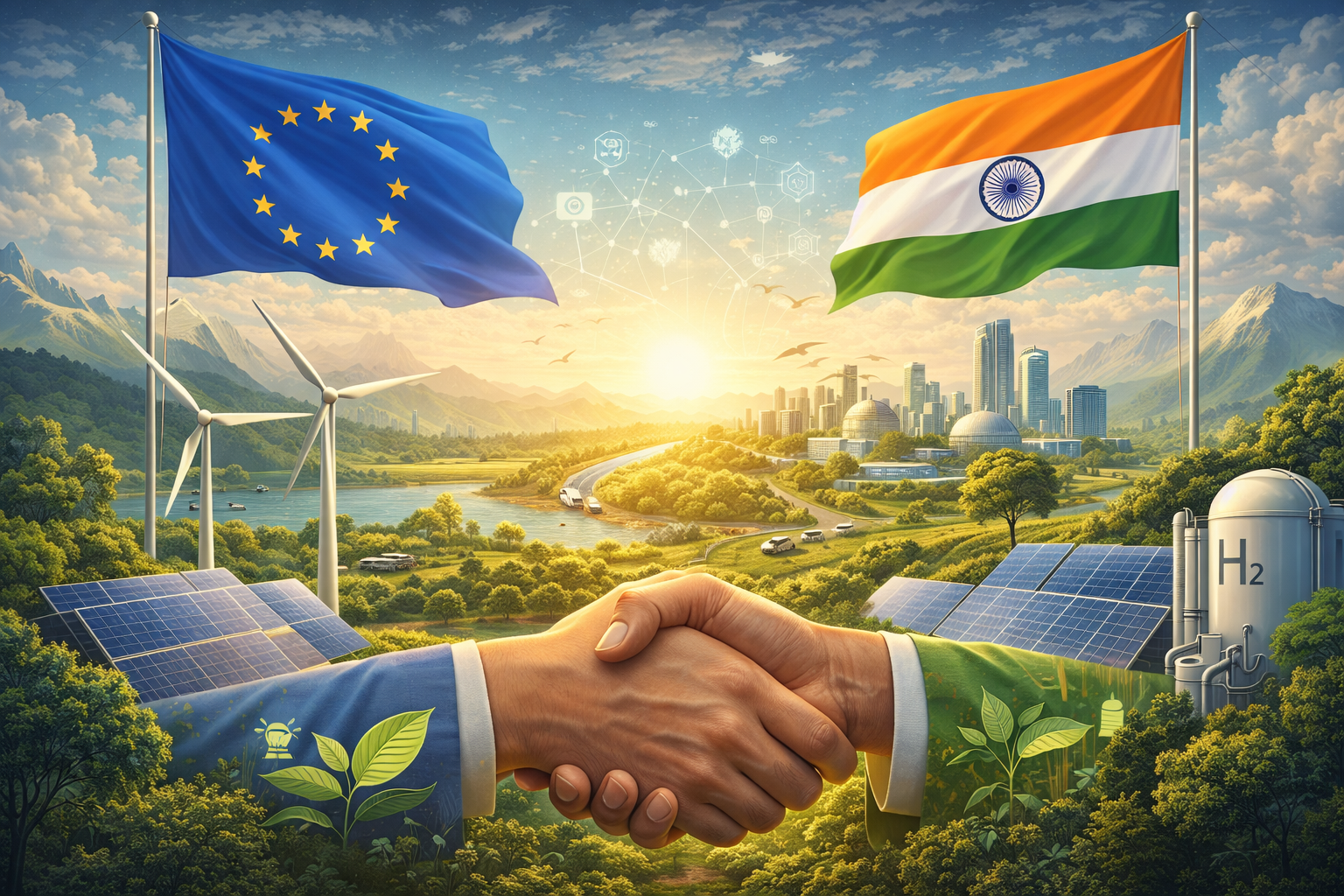
Beyond Trade Numbers
The EU–India partnership is often discussed in terms of trade volumes, tariffs, and market access, but its deeper significance lies beyond economic statistics. At its core, the partnership reflects a shared recognition that long-term prosperity cannot rely solely on growth figures or short-term gains. As global economies face climate stress, technological disruption, and social inequality, cooperation must extend into how growth is achieved, not just how fast it occurs.
Sustainability and innovation therefore sit at the heart of EU–India engagement. Both regions understand that economic expansion detached from environmental responsibility is no longer viable. The partnership acknowledges this reality by embedding climate awareness, technological cooperation, and responsible development into its broader framework. Rather than chasing rapid transformation, the focus is on durable and inclusive growth—growth that creates opportunity without exhausting resources, and innovation that improves quality of life without deepening inequality. This approach positions the partnership not as a transactional trade arrangement, but as a long-term alignment of priorities in a changing global landscape.
Shared Climate Commitments: Aligning Green Priorities
Climate policy has emerged as one of the strongest areas of alignment between the European Union and India. The EU has established itself as a global leader in climate regulation, emissions reduction targets, and environmental standards. India, meanwhile, has rapidly expanded its renewable energy capacity and articulated ambitious goals in solar power, wind energy, and sustainable infrastructure. While their developmental contexts differ, both sides recognize that climate resilience and energy transition are unavoidable strategic necessities.
This shared understanding creates space for collaboration rather than pressure. The partnership allows climate commitments to move beyond isolated national pledges toward coordinated action. Cooperation on emissions reduction, clean energy financing, and climate adaptation frameworks enables both sides to learn from each other’s strengths. Importantly, this alignment avoids symbolic declarations and instead emphasizes practical mechanisms—policy dialogue, joint initiatives, and long-term planning. In doing so, the partnership frames climate action not as a constraint on growth, but as a foundation for economic stability and resilience.
Green Technology and Innovation Collaboration
Innovation is where sustainability becomes actionable, and the EU–India partnership places strong emphasis on green technology collaboration. Areas such as clean energy systems, electric mobility, hydrogen development, and energy storage represent shared priorities with long-term impact. Europe’s advanced research capabilities complement India’s scale, engineering talent, and growing innovation ecosystem, creating opportunities for mutual benefit rather than dependency.
Research partnerships and technology exchange form a crucial pillar of this cooperation. Instead of simple technology transfers, the focus is on joint development, shared standards, and collaborative problem-solving. This approach strengthens innovation ecosystems on both sides, allowing solutions to be adapted to diverse economic and environmental contexts. By investing in knowledge exchange and co-creation, the partnership supports innovation that is both scalable and locally relevant. Over time, this model encourages resilience by reducing reliance on single sources of technology and fostering a more balanced global innovation landscape.
Sustainable Supply Chains and Responsible Manufacturing
Sustainability also reshapes how goods are produced and moved across borders. The EU–India partnership acknowledges that future supply chains must be not only efficient but also transparent, resilient, and environmentally conscious. Recent global disruptions have highlighted the risks of over-concentration and opaque sourcing. In response, the partnership promotes diversification, traceability, and responsible manufacturing practices as long-term goals rather than immediate obligations.
A key element of this shift is the emphasis on circular economy principles. Reducing waste, improving resource efficiency, and extending product lifecycles gradually become part of how industries operate. Sustainability standards, while challenging in the short term, have the potential to raise overall quality and competitiveness over time. For manufacturers, this means adapting production practices in phases rather than facing abrupt transformation. The partnership thus encourages steady alignment with environmental responsibility—allowing industries to evolve without compromising economic viability. In the long run, such supply chains are likely to prove more stable, trusted, and adaptable in a world increasingly shaped by environmental constraints.
Digital and Smart Solutions for Sustainable Growth
Digital infrastructure plays a quiet but critical role in advancing sustainability goals within the EU–India partnership. Technologies such as smart grids, digital logistics platforms, and intelligent urban planning systems allow resources to be used more efficiently without requiring drastic physical expansion. In energy management, digital tools help monitor consumption patterns, reduce losses, and integrate renewable sources more effectively into existing networks. In logistics, data-driven systems improve routing, cut fuel waste, and increase transparency across supply chains.
Artificial intelligence and advanced data analytics further strengthen these efforts by enabling predictive planning and real-time decision-making. Smart systems can anticipate energy demand, manage traffic flows in urban centres, and support more efficient industrial processes. However, technological progress must be balanced with responsibility. Issues of data privacy, cybersecurity, and ethical AI use are central concerns for both India and the EU. Aligning regulatory frameworks ensures that innovation supports sustainability without undermining public trust. The partnership recognizes that digital solutions are not just technical tools, but governance challenges that require shared standards and oversight.
Realistic Impact — Opportunities and Limitations
While the EU–India partnership holds long-term promise, its impact must be viewed realistically. In the medium term, cooperation can strengthen institutional capacity, encourage pilot projects, and gradually align sustainability standards across sectors. It can facilitate knowledge exchange, investment flows, and incremental innovation rather than immediate structural change. These gains, though modest at first, can compound over time if supported by consistent policy and political commitment.
At the same time, significant limitations remain. Sustainable technologies often involve high upfront costs, and scaling them across diverse economic environments is complex. Regulatory differences, administrative delays, and uneven implementation capacity can slow progress. Smaller businesses may struggle to adapt without targeted support, and public infrastructure upgrades require sustained financing. Recognizing these constraints is essential to avoid unrealistic expectations. Sustainability is not a switch that can be flipped overnight; it is a gradual transition that unfolds through experimentation, learning, and adaptation. The partnership’s strength lies in acknowledging these realities rather than overselling immediate outcomes.
Partnership as a Long-Term Sustainability Bridge
The EU–India partnership offers a compelling example of how global cooperation can move beyond narrow economic goals toward shared long-term responsibility. By integrating sustainability and innovation into its framework, the partnership positions itself as a bridge between developed and emerging economies navigating similar environmental challenges under different conditions. It demonstrates that progress does not require uniformity, but alignment around common principles and mutual respect.
Innovation and environmental responsibility, when pursued together, become investments in future stability rather than constraints on growth. The partnership underscores an important lesson for global cooperation: sustainable growth works best when ambition is matched with patience, and vision is supported by practical collaboration. In a world facing increasingly complex challenges, such balanced partnerships may prove more valuable than rapid but fragile transformations.
Related Posts

Epstein Files Controversy in India: How Old Diplomatic Emails Sparked a Political Storm

Assam’s Demographic Divide: Unpacking Himanta Biswa Sarma’s ‘Mia Muslim’ Comments and Border Imperatives