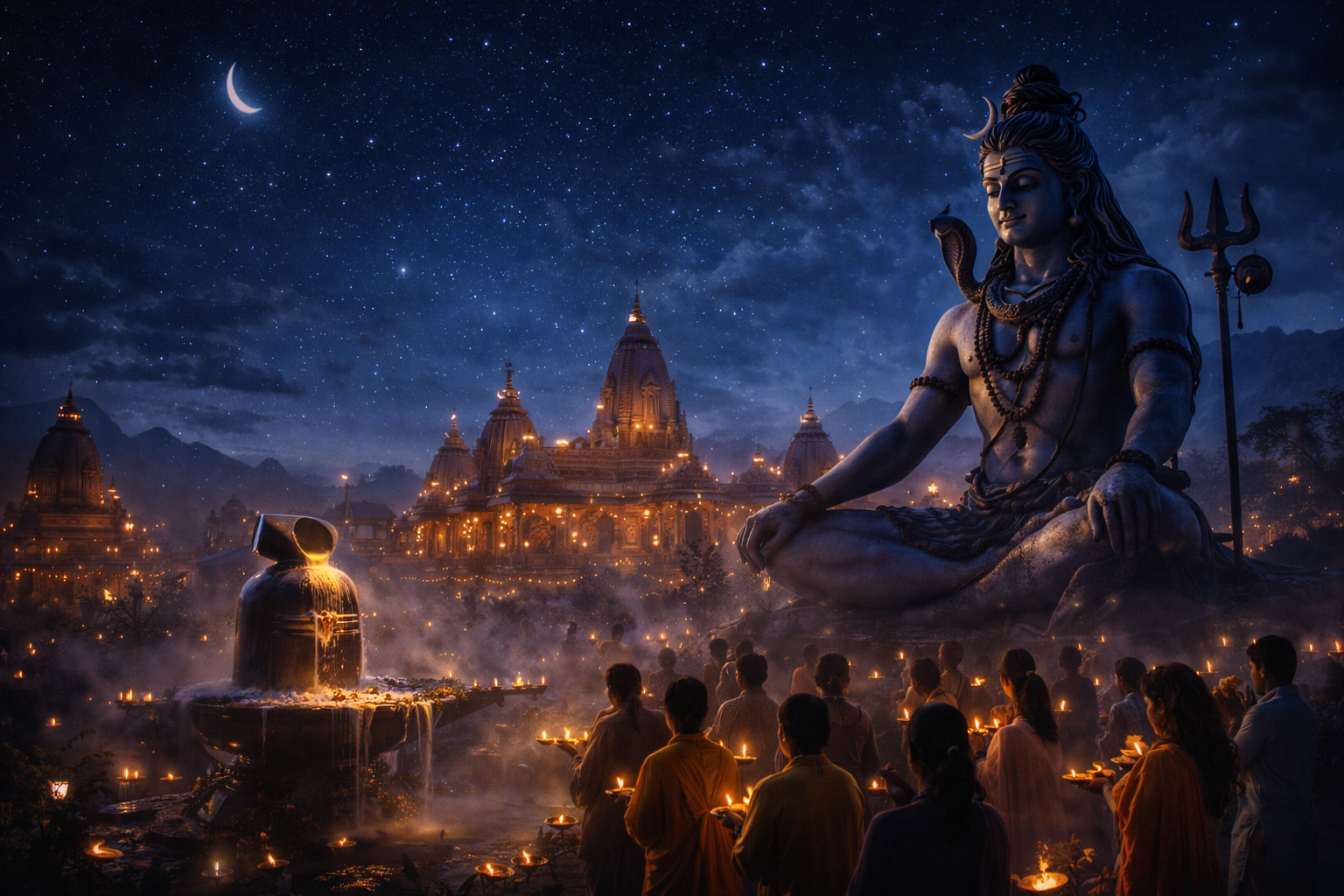
Mahashivratri, meaning “The Great Night of Shiva,” is one of the most sacred and spiritually significant festivals in the Indian tradition. Celebrated once a year, it is not merely a ritualistic observance, but a night dedicated to reflection, discipline, and inner awakening. Unlike many festivals that celebrate external joy through festivities and gatherings, Mahashivratri is a deeply inward journey, where silence, devotion, and awareness become the central themes.
At its heart, Mahashivratri commemorates Lord Shiva, the force of transformation. Shiva is not worshipped merely as a deity, but as a symbol of consciousness itself. He represents stillness in chaos, clarity in confusion, and awareness in ignorance. While creation and preservation sustain the world, transformation is what allows growth, and Shiva embodies that eternal principle.
One of the most unique aspects of Mahashivratri is its observance at night. Devotees remain awake through the darkness, engaging in prayer, meditation, and chanting. This act of staying awake is symbolic. It represents remaining conscious in a world that constantly pulls the mind toward distraction and unconscious living. The night becomes a metaphor for ignorance, and wakefulness becomes a metaphor for awareness.
Spiritually, Mahashivratri is believed to be the night when the energies of the universe align in a way that supports inner growth. Ancient yogic traditions emphasize that on this night, the human system becomes more receptive to transformation. Sitting upright, remaining alert, and turning inward are believed to help individuals experience deeper clarity and balance.
There are also legendary associations with this night. It is believed to mark the sacred union of Shiva and Parvati, symbolizing the harmony between consciousness and energy. This union represents balance, reminding humanity that strength and stillness, action and awareness, must coexist.
Beyond mythology and ritual, Mahashivratri carries profound philosophical meaning. It reminds individuals that transformation is not achieved externally but internally. In daily life, people often seek change in circumstances, relationships, or environment. Mahashivratri invites a different approach. It encourages transformation of perception, discipline of the mind, and mastery over one’s own impulses.
Fasting, which many observe on this day, is not merely a physical act but a symbolic one. It represents restraint, discipline, and the ability to step beyond immediate desires. By voluntarily limiting physical indulgence, individuals strengthen their inner will and awareness.
In modern times, where life is fast, noisy, and constantly demanding attention, Mahashivratri serves as a powerful reminder to pause. It reminds individuals to disconnect from noise and reconnect with themselves. It emphasizes that clarity, strength, and peace are not found in external achievement alone, but in inner stillness.
Ultimately, Mahashivratri is not just a religious observance. It is an opportunity. It is a night that invites reflection on who we are, how we live, and who we can become. It teaches that true power lies not in controlling the world, but in mastering oneself.
It is the night when silence becomes meaningful, stillness becomes powerful, and awareness becomes transformative.
Related Posts
Behavioral Changes in Relationships: Understanding Emotional Distance and Hidden Signals

The Hidden Cost of a Tech Career: What Success Quietly Takes Away