When Policy Reaches the Pavement
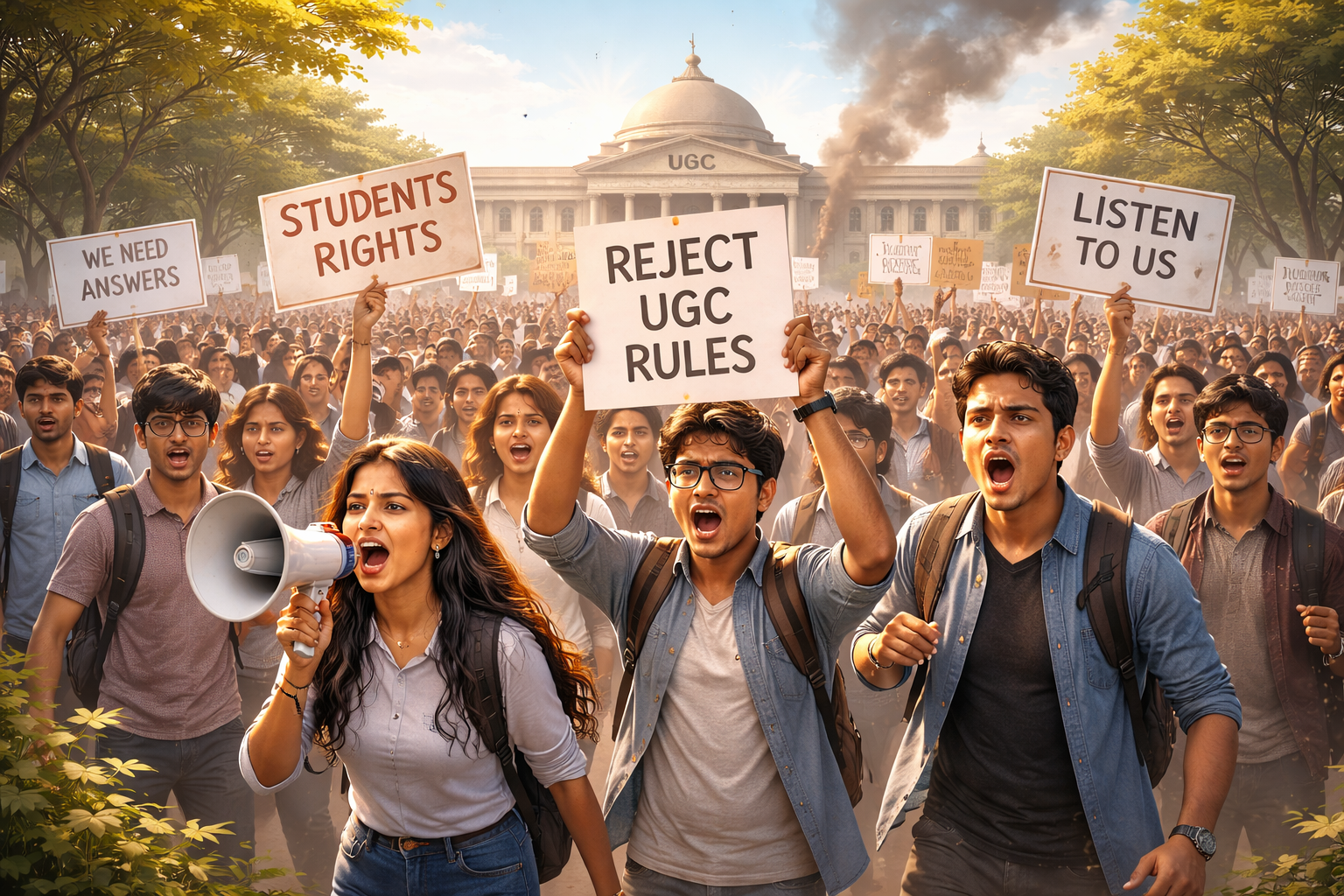
On campuses across the country, students gathered on streets they usually cross without a second thought. Handwritten placards, raised voices, and uneasy silences filled spaces meant for lectures and conversations. Some protests were loud, others quiet, but all carried the same undertone—uncertainty. The immediate spark was the UGC’s 2026 notification on equity regulations, but what brought students to the streets ran deeper than the document itself.
For many, the notification arrived not as a clearly explained policy but as a sudden disruption to an already fragile academic environment. It entered lives already shaped by delayed exams, shifting admission rules, and constant institutional changes. What followed was not just disagreement, but fear—fear of unclear consequences, of rules being interpreted unevenly, and of decisions being made without those most affected in the room. Beyond clauses and legal language, the notification began altering daily routines, mental states, and future plans. This story is about that human cost—where policy stops being abstract and starts pressing against real lives.
Confusion on Campus : “Nobody Explained What This Means”
For most students, the notification did not arrive through official briefings or structured communication. It arrived through screenshots on WhatsApp, hurried Instagram posts, forwarded messages stripped of context, and loud interpretations rather than clear explanations. Rumours travelled faster than facts. In hostels, classrooms, and online groups, students tried to decode what the rules meant for them—often with incomplete or contradictory information.
Universities and authorities were slow to respond with clear guidance. Notices, where they existed, were often written in dense administrative language that failed to address practical concerns. Students were left guessing how the rules would be applied on their specific campuses, who would have authority, and what protections existed for all parties involved. This vacuum of communication created anxiety that fed on itself. When clarification is delayed, imagination fills the gaps—and in tense environments, imagination often leans toward worst-case scenarios.
Protests Across Cities : A Generation Speaking Up
What began as isolated expressions of concern soon spread across cities and campuses. From central universities to state institutions, students gathered to demand clarity, consultation, and reassurance. The protests varied in scale and tone—some organised through student unions, others emerging spontaneously—but the message remained consistent: decisions affecting students’ futures cannot be imposed without dialogue.
Many students said they protested not because they rejected equity or fairness, but because they felt unheard. Waiting quietly felt risky when uncertainty threatened academic stability. The emotional atmosphere of these demonstrations reflected more than anger. There was fear about being misunderstood, frustration with opaque governance, exhaustion from years of disruption, and a growing sense that student voices were peripheral in policy decisions that shaped their lives. The streets became spaces not just of protest, but of collective expression—where anxiety found a shared language.
Academic Uncertainty : Admissions, Exams, and Careers in Limbo
One of the most immediate concerns among students was academic unpredictability. Questions surfaced around admissions criteria, evaluation standards, disciplinary processes, and grievance mechanisms. Final-year students worried about delays affecting placements and higher-education applications. Aspirants feared that changing interpretations of rules could impact entrance processes or merit assessments.
There was also unease about procedural fairness. Students expressed concern over whether complaints could stall exams, delay results, or create prolonged uncertainty during crucial academic phases. For those standing at the edge of graduation or competitive entry points, even temporary disruption felt consequential. In an education system where timelines already shift frequently, the lack of clarity intensified a sense of vulnerability. Careers felt paused, futures felt fragile, and trust in institutional stability weakened further.
Mental Health Under Pressure : Anxiety Beyond the Classroom
As confusion spread across campuses, the psychological toll became increasingly visible. Students described persistent anxiety, difficulty concentrating, sleep disturbances, and a constant sense of being on edge. For many, this stress did not arise from the content of the regulations alone, but from the uncertainty surrounding how they would be applied. When rules are unclear, fear fills the silence.
Campus mental-health systems, already strained by years of pandemic-related disruption and academic uncertainty, struggled to absorb the surge in distress. Counselling centres reported higher demand, while students in smaller institutions often found little to no professional support available. Some students spoke of feeling trapped between academic expectations and an invisible pressure that made even routine interactions feel risky. One student described the experience as “carrying a constant fear that something I don’t understand could suddenly affect my future.” The emotional cost, while difficult to quantify, has been real and cumulative.
Voices From the Ground : Students, Not Statistics
The impact of the notification has not been uniform. Students from different social and economic backgrounds have experienced the uncertainty in distinct ways. Some worry about being unheard, others about being exposed, and many about being misunderstood. A first-generation college student spoke about fearing procedural complexity, unsure whether they would have the resources or support to navigate complaints or defend themselves if needed. Another student from a marginalised background expressed concern that confusion could weaken protections meant to help them, rather than strengthen them.
Across gender lines, economic realities, and academic disciplines, the common thread has been a feeling of exclusion from the conversation. Students did not describe themselves as resisting equity or fairness. Instead, they spoke of wanting clarity, safeguards, and participation in decisions that shape their daily lives. What troubled them most was not disagreement, but invisibility—the sense that policies were being crafted about them, without them.
The Trust Deficit : Students vs Institutions
This episode has deepened an already fragile trust between students and educational authorities. Many students feel that institutions communicate selectively—asserting authority when enforcing rules, but retreating into silence when questions arise. This imbalance has reinforced the perception that governance happens in one direction.
Trust in institutions depends not only on legality, but on legitimacy. Students are more likely to accept difficult regulations when they understand them, feel consulted, and believe safeguards exist for everyone involved. When that trust weakens, even well-intentioned policies are met with suspicion. The protests, in this sense, are less about rejection and more about reclaiming voice in systems that increasingly feel distant and procedural.
What the Streets Are Really Saying
The demonstrations unfolding across campuses are not calls for chaos or rejection of equity. They are demands for clarity, fairness, and dialogue. Students are asking to be treated as stakeholders rather than subjects of regulation. They want protection without fear, accountability without arbitrariness, and reform without exclusion.
At its core, this moment reveals a simple truth: policies succeed only when people trust the systems enforcing them. When that trust erodes, the streets become spaces of negotiation. The voices raised there are not merely opposing a notification—they are reminding institutions that education is not governed by paperwork alone, but by relationships built on transparency and respect.
v
Related Posts
Epstein Files Controversy in India: How Old Diplomatic Emails Sparked a Political Storm

Assam’s Demographic Divide: Unpacking Himanta Biswa Sarma’s ‘Mia Muslim’ Comments and Border Imperatives